July 2025 Quarterly Update

Welcome to Summer 2025.

If you look at the performance of the stock market over the past three months, you might think that everything is going quite well in our world. The reality is anything but. Consider:

  1. Iran and Israel traded missile attacks against each other in the Middle East starting June 13.
  2. The United States carried out strikes against Iran on June 22.
  3. The war in Ukraine is more active than ever with both Ukraine and Russia making multiple missile strikes on each other this past month.
  4. The humanitarian crisis in Gaza has deepened as Isreal presses its bid for control of the area.
  5. The United States continues to wage a trade war against its major trading partners including China, Mexico and Canada.
  6. China continues to prepare itself to take Taiwan by force. This would be a huge blow against the West and would likely embolden other nations such as North Korea to follow suit against American allies.

There is a seeming disconnect between the performance of your investments and what is going on in the world. A new meme[1] “Nothing Ever Happens” describes the cynicism that many investors feel as seemingly catastrophic events lead to little or no market movement. This phenomenon is not new.


[1] I live with four teenagers and so feel compelled to do my best to work with their language. “Meme” is a theme that is shared widely. It could be a picture, video or (in this instance) a piece of text.

Making Sense of a Stock Market that Seems to Ignore Headlines

In 1988, just as I was completing my undergraduate degree, three academics: David Cutler, James Poturba and Lawrence Summers (who served as the US Secretary of the Treasury from 1999 – 2001) published a paper entitled “What Moves Stock Prices?”. In this paper they looked at major events such as the bombing of Pearl Harbour in 1941, the Cuban Missile Crisis in 1962 and the Chernobyl Nuclear meltdown in 1986. What they found is that stock market responses were surprisingly muted as important world news was reported. (Source: Cutler, David M. and Poterba, James M. and Poterba, James M. and Summers, Lawrence H., What Moves Stock Prices? (March 1988)).

Thirty seven years after this paper was published, the results are the same: investors react to news that they believe will meaningfully impact the value of their investments. News of war generally leads to all-or-nothing outcomes which is difficult to price. Economic news such as interest rates and/or the imposition of tariffs can be more easily factored into the price of a stock.

The lesson in all of this is to remember that a headline that catches your attention may not result in a change in the value of the shares you own. This was true over eighty years ago and still true today. 

How to Avoid Being Scammed

The Canadian Investment Regulatory Organization (CIRO) which regulates investment activities in Canada, issued a warning to Canadian Investors (and seniors in particular) to be careful because scammers are becoming increasingly sophisticated and pervasive. Among the tips offered, they highlight naming a trusted contact person to your investor profile. This person, who can be a family member or friend, can look out for you and assist us in giving you the best-possible advice and especially keep a lookout for scams on your behalf. In a world of ubiquitous technology and artificial intelligence, relationships matter more than ever. We encourage you to nurture trusted relationships and use them for your protection. Please reach out if you would like to add this feature to your profile.

Financial Literacy for the Next Generation

On May 31, we were pleased to host a group of young people here at our office for a seminar designed to build financial literacy and specifically explain how the First Time Homebuyers Plan works. We had several of you ask for a recording of this session which you can access here.

Prices, Currency and Interest Rates

The bank of Canada reported that Canada’s inflation rate is holding steady at 1.7%.  They also held the overnight rate steady at 2.75%. This leaves borrowing costs well below the 5.00 level they were at just over one year ago and price stability that is well within the bank’s target range. I believe these conditions are positive for everyone: governments, businesses, investors and consumers.  (Source: Bank of Canada)

April 2025 Quarterly Update

Sometimes in my client conversations the term “the market” is invoked, most often as a noun, as in “what is THE MARKET doing?” or “how did THE MARKETS perform?” or “how does Donald Trump’s latest headline affect THE MARKET?”. I must confess that I also slip into thinking of “THE MARKET” as a sentient, singular and temperamental being. So please forgive me if what I am saying seems redundant. I think it’s good to reflect on what the market is, what it is not and why this matters.

Defining THE MARKET

There are physical markets such as the St. Jacobs Farmers Market (just down the road from our office), there is a labour market where employers seek employees and workers seek jobs, and financial markets where financial instruments such as stock, bonds and currencies are traded.  In economics, a market refers to “any structure that allows buyers and sellers to exchange any type of goods, services, or information, influenced by factors such as supply and demand, competition, and government regulations”.

What is MARKET PERFORMANCE?

Together we own mutual funds that hold stocks and bonds that operate and trade all around the world. Because these securities are publicly traded, investors have an opportunity to buy or sell their them in those markets every business day. To the extent that investors can legally, securely and efficiently trade, we might conclude the market has performed well because it has done what it is supposed to do. But when we make reference to markets performing well, or poorly, it has an entirely different meaning.

I believe this has more to do with supply and demand. For example, five years ago today, the prices being offered for securities traded in US stock markets had dropped by 35.4% in just over one month (February 20 – March 23, 2020). In the first 10 months of 2022, prices dropped again by 26.7%. Did the markets perform poorly during these timeframes? Given the constraints of COVID in 2020 and a rapidly changing interest rate environment, I would argue that markets performed very well because people were able to continue buying and selling despite restrictions (the St Jacobs Market was closed from March to June 2020) and uncertainty in 2022. What was significant about 2020 is that there were very few buyers and many sellers – and this abundance of supply and limited demand is what led to prices declining. In hindsight, one of the best buying opportunities we have had in the past ten years was right around now five years ago, when the market was flush with sellers and very few buyers. (Source: yahoo.ca/finance)

THE MARKET as an Index

Another definition I encounter is the market represents the price of all available securities. Perhaps the best example of this is the S&P 500 index which many of you own in the RBC US Equity Index Fund. Last year this fund increased dramatically in value as demand for the largest growth companies in the world (Apple, Nvidia, Microsoft, Alphabet, Meta, Microsoft, Tesla) increased. When the media is reporting on stock market performance, they will report on the price of the index. If it goes up in value the charts will appear green and if they go down, they appear red. We might feel happy when we see green and fearful when we see red.

The Performance of Your Investments is Different from THE MARKET

The combined value of the 500 largest publicly traded securities in the US decreased by 4.9% during the first quarter, this does not necessarily apply to your investments. At the end of the quarter, I did a review of many client portfolios and almost all of them had increased in value. There are a few reasons for this:

  1. You hold cash in your portfolio either in a separate investment or within your mutual funds. Cash contributed some interest income to the overall value during the first quarter.
  2. For the first time in a long time, the value of bonds increased over the course of the quarter while the value of shares in the broader market decreased. This was helpful.
  3. The value of the securities in the EdgePoint Global portfolio increased by 3.1% during the quarter. This is neither something to celebrate or worry about, but it is noteworthy. EdgePoint portfolios are actively managed investments whose performance is very different from the market. In my experience, an actively managed mutual fund will often perform relatively well when prices in the overall market drop. This is generally due to two main factors:
    • The businesses in the portfolio have been carefully researched and selected for the portfolio based on factors such as their value and resilience.
    • The managers have avoided investing in securities that are popular when values are going up (think: Tesla).

We are committed to assisting you with reaching your financial goals. We address planning, estate and tax issues, and we also use both market-based AND actively managed mutual funds because we believe this is the optimal solution to get you to where you want to go without too many ups and downs along the way.

January 2025 Quarterly Update

“Games are won by players who focus on the playing field – not by those whose eyes are glued to the scoreboard.”

– Warren Buffett

I wanted to share this quote with you because I believe that one of the biggest threats to long-term investment success is paying too much attention to the value of our investments today. Our financial plans are designed to feed, clothe and house our families in the future. It is important to be aware of our portfolio values but not to make it our focus.

We at Thomson Allison want to deliver pleasing investment results to you over the long term. If seeing higher investment values in the short term seems pleasing to you, I encourage you to temper this in the same way that I would encourage you to temper your perspective had the value of your investments gone down in 2024.

In October 2022 (when markets were down over 10% year-to-date) I wrote “a decision to remain committed to a long-term investment plan is easy when markets are up, and difficult when they are down.” Our investment values have increased substantially since then. If it feels easy to be invested the way you are now, please remember that there will be times in the future where it will feel difficult. We will remain committed to our approach regardless of how we feel.

Some Themes From 2024

Monetary Policy vs Political Theatre

Some of you expressed concern that the 2024 US election results could lead to instability in our world and in the value of your investments. I wanted to provide you with some examples of destabilizing news and how efficient the stock market is at anticipating and adapting to new information:

  1. On December 1, 2024 United States president-elect Donald Trump announced that he would impose 25% (or higher) tariffs on imports from Canada, Mexico and China when he comes to power. Stock markets remained unchanged that day.
  2. On December 23, 2024, Donald Trump again announced that he would “lock down” the US border. He openly discussed the possibility of purchasing Greenland from Denmark and indicated that he was willing to retake the Panama canal from Panama. Stock markets were unchanged that day.
  3. On December 17, 2024, Jerome Powell, chairman of the US Federal Reserve Board, announced an interest rate reduction of .25%. In his comments, he led investors to believe that the board may not proceed with as many further interest rate reductions in 2025 as they had anticipated. The Dow Jones Industrial Average dropped over 1,000 points (~3%) that day.

I am highlighting these three announcements to remind you that professional investors are watching, listening to and reading the news in the same way that we are. When information is broadcast that seems credible and actionable (see #3), they will move quickly and decisively as they did on December 17. They are not ignoring Donald Trump (see #1 and #2) but they do not place much credibility in his claims so they are not acting on them. Much of what we see coming from politicians is interesting to hear, but it often amounts to nothing more than political theatre and has little to no impact on our investment plans.

Canadian Dollar vs US Dollar

The US dollar and economy continued to dominate all others. Over the course of the year, the Canadian dollar dropped from over 75 cents in USD to less than 70 cents. This is a decrease of 7.95%. Most of your investments are held in US-based securities so this had the effect of increasing your rates of return in Canadian dollars. (Source: yahoo.ca/finance)

Magnificent Seven vs All Others

“Magnificent Seven” is a term that has come to represent the seven dominant technology companies in the United States. These companies are: Apple, Meta (Facebook), Alphabet (Google), Nvidia, Microsoft, Tesla and Amazon. The chart on the left shows that their combined value is close to 40% of the value of all the largest businesses in the US. Much attention is paid to these seven stocks for many reasons, the least of which is simply their sheer value. Consider, for example, the value of Apple Inc. It would cost you $5.2 trillion CAD to purchase the entire business. If you added up the value of ALL the companies listed on the TSX (Canadian stock market), it would total $4.2 trillion CAD. To be clear, if you owned one business (Apple Inc.) and sold it to someone else, you would have enough money to purchase EVERY publicly-traded business in Canada (all the banks, railroads, pipelines, energy companies etc.) and still have $1 trillion left over for spending money 😉. We remain concerned that the value of these seven companies is so overwhelmingly high. I should also note that EdgePoint does not currently hold any shares of the magnificent seven in its portfolios. In the index funds (RBC US Equity Index), the magnificent seven are dominant. (Source: TSX.com, yahoo.ca/finance

October 2024 Quarterly Update

Why Growth is Important

We manage your investments for growth because we think it’s important to be able to afford things in the future. It is one thing to increase the value your investments, it is another thing altogether to grow your investments in a world where prices are rising at a faster rate than our investments. Take, for example, the price of groceries.

StatsCan reports that the price of groceries has risen by 27% over the past five years. I was interested to note that the value of 1-year GICs invested over the same timeframe would have grown by 15% (pre-tax). The following chart shows that the price of a $100 bag of groceries has risen to $126.70 and the value of a $100 GIC re-invested each year has grown to $115.31.

Groceries and GICs over 5 years.png

We wondered what rate of return would have been required in order to still be able to purchase the same groceries today that we did back in 2019. An investment made on September 1, 2019 to August 31, 2024 would have had to grow at a pre-tax annual compound rate of 6.7% (assuming a 30% tax rate). Growing capital at this rate is not an easy task – and it is impossible without assuming some volatility risk along the way.  

Housing Market Update

On September 27, 2024 I recorded a conversation with Christian Chiera at the Royal Bank of Canada concerning the housing market. I encourage you to check out his observations.  

Housing Market Down.png

Click here to view the presentation. 

Housing Market Update, recorded on September 27th, 2024. This has been provided by RBC Global Asset Management Inc. (RBC GAM) and is for informational purposes, as of the date noted only. It is not intended to provide legal, accounting, tax, investment, financial or other advice and such information should not be relied upon for providing such advice. RBC GAM takes reasonable steps to provide up-to-date, accurate and reliable information, and believes the information to be so when provided. Past performance is no guarantee of future results. Interest rates, market conditions, tax rulings and other investment factors are subject to rapid change which may materially impact analysis that is included in this document.  You should consult with your advisor before taking any action based upon the information discussed. All opinions constitute our judgment as of the dates indicated, are subject to change without notice and are provided in good faith without legal responsibility. Information obtained from third parties is believed to be reliable but RBC GAM and its affiliates assume no responsibility for any errors or omissions or for any loss or damage suffered.

Value vs Growth Investing

I will close with a comment on an old theme: Value versus Growth investing.

Value investing refers to an investor who purchases a business to benefit from the profits that business is generating today and in the near future. An example of a value investment would be Bell Canada (BCE) which pays out annual dividends of over 8% to investors. Someone investing in BCE might be focusing more on how they can be paid today for their investment versus how they might be paid in the future. BCE contrasts with a growth investment such as NVIDIA, a maker of computer chips. NVIDIA pays very little dividends and is valued very highly in the marketplace. An NVIDIA investor is likely paying more attention to the profits they expect to earn in the future and is willing to forego profits and dividends today.

It is no secret that the increase of the share prices of growth businesses has been far better than the increase in share price of value businesses over the past few years. Looking forward, we continue to be careful – not chasing investments in growth businesses because of that increase. We believe that a healthy allocation to value businesses in addition to growth will serve us well in the years to come.

July 2024 Quarterly Update

Our investment approach generally considers two key factors: Macroeconomic and Microeconomic.

Macroeconomic Themes

Macroeconomics examines large-scale economic factors such as inflation, interest rates, productivity, and government policy. Here are our macroeconomic observations from the past three months:

Inflation & Interest Rates

Central banks in developed economies are working to bring down inflation. Canada’s inflation rate dropped to 2.7%, within the acceptable range of 1% to 3%, signaling price stability which is beneficial for planning and investing. The Bank of Canada recently reduced its policy interest rate to 4.75%, the first among G7 nations. More cuts may follow this summer. (Source: Bank of Canada)

Economic Growth

Canada’s economy grew by 0.5% in the past year. However, per-capita GDP decreased by 0.75% when we factor in our 1.25% population growth over the same timeframe. Based on per capita GDP growth, the average Canadian is slightly worse off compared to a year ago. (Source: Economist)

Renewal Rate Risk

The Office of the Superintendent of Financial Institutions (OSFI) reported that 76% of mortgages will come up for renewal by the end of 2026. Higher mortgage rates (which will still apply – even with recent rate reductions) could lead to payment shock for homeowners, particularly those with variable rate mortgages that are negatively amortizing. (Source: http://www.osfi-bsif.gc.ca)

Understanding macroeconomic trends is useful, but these factors are generally beyond our control. We are well-served to remain focused on microeconomic themes and decisions to best grow and protect what is ours.

Microeconomic Insights

Microeconomics focuses on individual-level economic factors such as personal spending, investment decisions, and incentives. Here are some key points we are considering:

Mutual Fund Enhancements

Recent amendments by Canadian Securities Regulators have shortened the settlement cycle for mutual funds to one day. This means you can now access redeemed funds within three business days, making mutual funds even more convenient and liquid.

Artificial Intelligence and Fraud

A recent case at the British engineering firm Arup involved AI impersonation to convince a firm employee to send HK$200 million (CAD$35 million) to a criminal organization. Artificial Intelligence increases the risk of fraud to us all. To combat such risks, we emphasize authentic relationships with you. When you request funds, we may initiate a conversation to confirm that it is really you, not to make your life difficult, but to ensure your protection through a strong, trusting and personal relationship. (Source: The Guardian)

Government Programs and Incentives

We enjoy discussing government programs (such as CPP and OAS) and incentives (FHSAs, RESPs etc.) with clients. We tailor our advice to individual circumstances, avoiding one-size-fits-all rules. We’re here to help you make the best decisions for your specific situation.

Over the past month or so we have especially enjoyed conversations with you, wanting to make good decisions concerning these government programs and incentives. In these conversations we review several individual factors before offering our advice. We also find that it is counterproductive to apply a general rule such as “wait to apply for CPP” or “everyone should get an FHSA”. Each of our circumstances are unique and the best decisions are usually made focusing on microeconomic themes. We are always honored to engage in discussions with you to ensure you make the best-possible decision – just for you.

April 2024 Quarterly Investment Update

Inflation

Canada’s inflation rate recently dipped back below 3%, moving within the Bank of Canada’s targeted long-term rate band of 1%-3%. Despite this encouraging development, the persistent reminder of escalating prices remains undeniable. A glance at the Bank of Canada Inflation Calculator reaffirms this reality. Today, my calculation revealed that an item priced at $100 in February 2019 would have surged to over $118 by February 2024. That’s a significant increase.

Sometimes on Saturday mornings, I indulge in a visit to our local Tim Hortons – treating myself to a breakfast sandwich, a chocolate chip muffin, and a tea. However, with the recent opening of Elmira’s first Starbucks, I decided to splurge and try their offerings instead. To my surprise, the same three items: an egg sandwich, tea, and a chocolate croissant, set me back $19.68 (including the $2 tip I was prompted to give). While the breakfast was enjoyable, the dent it made in my wallet lingers and I think I will head back to Tim Hortons in the meantime.

I’m thankful that I don’t need to eat at Starbucks to survive. However, in many other respects, evading the relentless impact of inflation proves challenging. That’s why we are pursuing growth in our investments, aiming to mitigate the effects of inflation on our lives. With that goal in mind, I share our investment and economic insights below.

Valuations Up

In the first quarter of 2024, valuations soared as investors anticipated forthcoming interest rate reductions. Warren Buffet’s timeless advice to “be fearful when others are greedy and greedy only when others are fearful” is particularly pertinent in such times. I don’t observe much greed – yet. This is a good thing. We are well-served to understand prevailing themes in the stock market as we journey on.

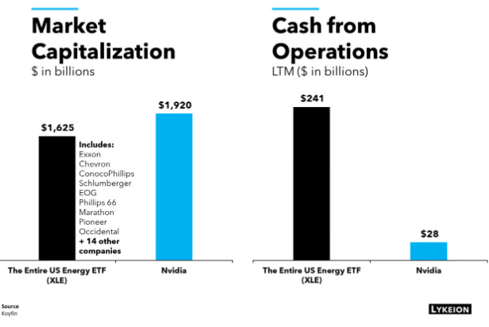
The first theme is the difference in valuation between mega-cap and all other businesses. Consider, for instance, the valuation of NVIDIA, a leading producer of chips for Artificial Intelligence applications. With a market capitalization (i.e. what it costs to buy the company) nearing $2 trillion and annual cash generation of $19 billion, NVIDIA yields less than 1%. On the other hand, investing in the 23 largest US energy companies, with a combined market cap of $1.645 trillion, yields close to $241 billion or 15% annually.

(Source: Lykeion)

Small Cap vs Large Cap Stocks

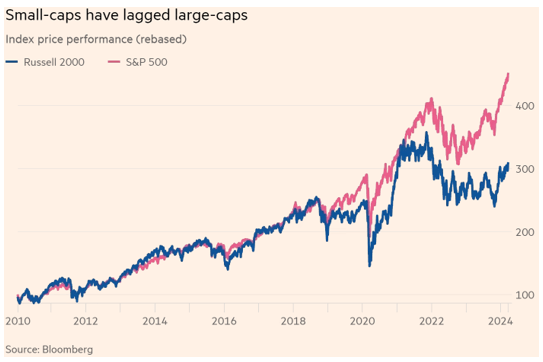
Second, the growth in value of Small-cap stocks, valued at $2-3 billion on average, has trailed behind large (S&P 500) stocks, we believe there is significant opportunity in these smaller-cap stocks.  It is easy to be in love with the S&P 500 based on its recent performance. We need to also exercise caution and understand the associated risks.

(Source: Financial Times)

Canadian Productivity

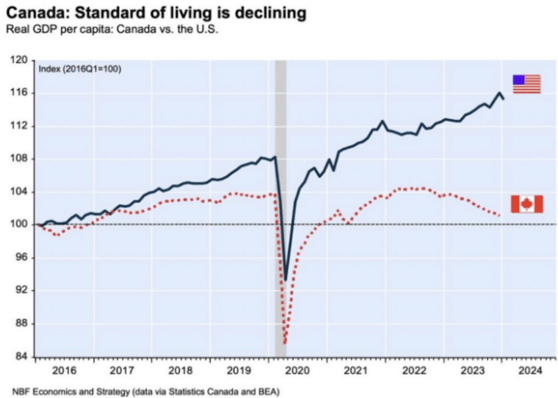
Last, the chart below shows that Canada’s productivity is lagging that of the US (Source: National Bank Financial). This is important because economic productivity enables us to financially protect what is ours. Our inability to grow our productivity puts us further behind and less able to pay for the things that matter to us collectively such as public health care, education and welfare. In short, because of these productivity gaps, our American neighbors have more resources available to pay for things, regardless of our political or ideological differences.

It’s crucial to note that a significant portion of your mutual fund investments are allocated to businesses located outside Canada, with a notable emphasis on the United States. The US economy has demonstrated remarkable productivity, resulting in increased profits and returns for business stakeholders. As investors, we reap the benefits of this heightened productivity.

Team News

In team news, earlier this month we bid farewell to Garrett Boekestyn who is pursuing an opportunity elsewhere. We will miss his good cheer and financial skills as we wish him all the best in his future endeavours. We also welcomed Christine Tullio to our team. She will be helping us out through to the end of tax season. Please be sure to welcome her as you call or stop by.

January 2024 Quarterly Investment Update

Welcome to 2024 – a new year filled with well-worn headlines: war in the Middle East, Europe and Africa, recession fears and a looming Trump presidency.

What are we to make of these headlines? From an investment standpoint, very little. We crave certainty but we live, work and invest in a very uncertain world. We focus instead on the things that are less uncertain (inflation, retirement, death and taxes) and combine our opinions in these areas with decisions that tilt outcomes in your favour (optimally allocating your investments between business ownership, bonds and cash). This is our recipe for success. It has served our clients well for over 50 years and will continue to do so for the next 50.

Investment Comparison

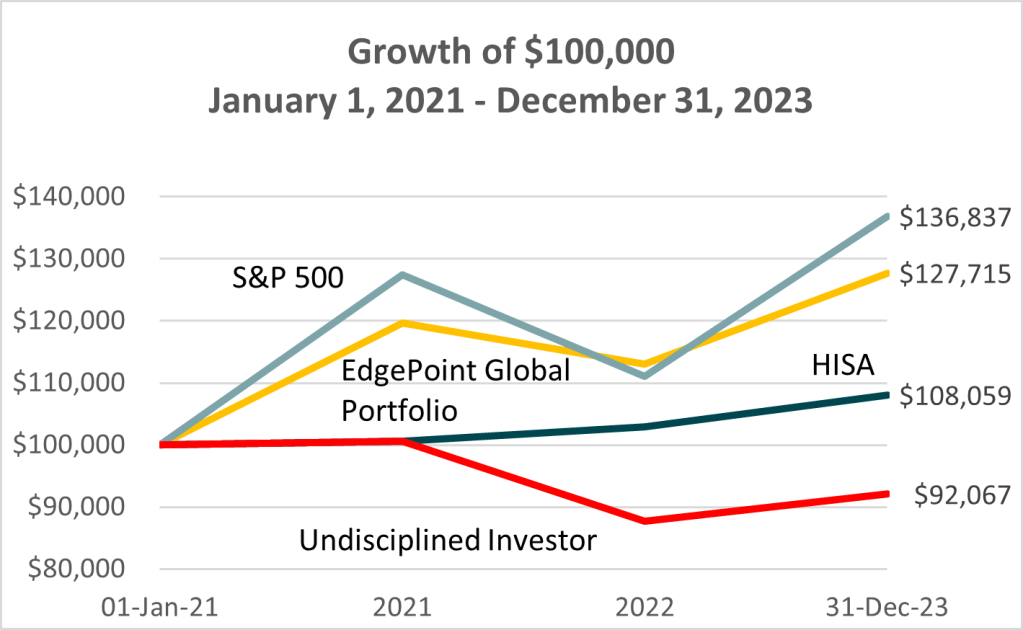
Let’s begin the year looking at three different investment solutions.  Which of the following three investment choices: EdgePoint Global Portfolio. S&P 500 and a High Interest Savings Account (HISA) would have delivered the best results to an investor with $100,000 from the beginning of 2021 through to the end of 2023?

The answer is not simple. The investor who is unable to tolerate volatility is best off in the HISA. The investor with minimal concerns for volatility is best off in the S&P 500 index and the investor who wants to enjoy growth with some downside protection, is best off in the EdgePoint Global Portfolio.

But the most important lesson we can learn from this exercise is that the investor who bases their decisions on past performance (Undisciplined Investor) is the one who is at greatest risk.

This investor (still spooked from 2020) starts out investing in the HISA in 2021 then, seeing the great performance in the S&P 500, switches to it at the start of 2022 then moves back to the HISA in 2023 following a difficult 2022 and finishes the three-year cycle with less money ($92,067).

If nothing else, the past three years remind us that we can no more succeed in investing by looking at past returns than we can successfully drive a car by looking in the rear-view mirror.

1-Year3-Year5-Year10-Year
CI High Interest Savings Fund (HISA)5.04%2.55%n/an/a
EdgePoint Global Portfolio Series F6.82%8.04%5.56%10.23%
iShares Core S&P 500 Index (XUS)13.49%11.07%12.57%14.18%
Source: ci.ca, edgepointwealth.ca, blackrock.com/ca

Additional Thoughts

Inflation & Interest Rates. While the consumer price index appears to be returning to a normal range (3.1% over the past 12 months to November 30 – down from its peak of 8.1%), the two most important components of the index, food and shelter, remain at stubbornly high rates running at 5.6% and 6.1% respectively (Source: Statscan.gc.ca). The Bank of Canada remains cautious on declaring the war on inflation over and have signaled that interest rates will need to remain higher for longer.

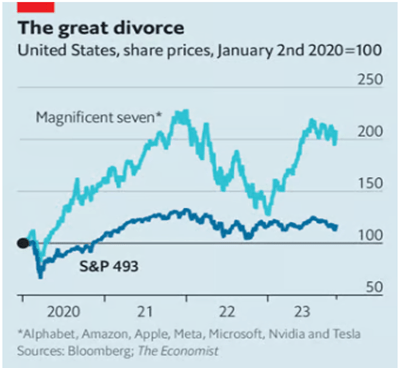
The S&P 493? Much of the spectacular performance of the S&P 500 over the past few years has been driven by seven businesses: Alphabet (Google), Amazon, Apple, Meta (Facebook), Microsoft, Nvidia and Tesla. These businesses account for 29% of the index (in Canada, the top six banks account for 20% of the entire index).  The other 493 stocks are older-economy businesses such as Berkshire Hathaway, Eli Lilly and JP Morgan Chase. These are all successful, innovative businesses who have not grown to the degree of the spectacular seven. We are well-served to understand what lies beneath the performance of an index such as the S&P 500 and to seek proper diversification. This is where these other 493 businesses become very important to our strategy and why it is important to look beyond indexes. (Source: The Economist)

Disability and Critical Illness Insurance

Welcome to the second and final post in our series on insurance. Last month we covered life insurance and now we will explore disability insurance and critical illness insurance. All three types of insurance should be considered when putting together a plan to protect your finances.

Disability Insurance

Disability insurance pays a monthly amount if you are unable to work due to illness or accident. It is meant to replace employment income while you are unable to work. It pays between 60 – 85% of your gross income, depending on the policy.

DO I need Disability Insurance?

  • If you have debts or loved ones who depend on your ability to earn an income, then you need to consider disability insurance. 
  • Many people will have disability insurance coverage as part of their employment benefits. Be sure to review any policy provided through your employment.
  • An emergency fund which can be used to cover short-term disability would struggle to cover a long-term disability. Insurance should be considered for protection from long-term disability.

Disability Insurance Options

There are many different options within disability insurance, below are a few important considerations.

  • Any occupation coverage – Pays out benefits when you are not able to work in any occupation that you’re reasonably qualified for based on your experience and education.
    • This means that even if you suffered an injury where you couldn’t work your current job you would not necessarily receive a payout. Instead, the insurance company would look to see if there are other jobs you could perform with your injury. If there are such jobs, they may deny payment. 
    • An insurer cannot say that an architect who is injured could instead work at a fast-food restaurant and therefore is not covered. They must compare to jobs that fall within your education, training, and experience.
    • Any occupation coverage tends to be cheaper as there is a higher chance of a claim not being paid.
  • Own occupation coverage – Pays out benefits when you are unable to work in your own occupation. If you cannot perform a substantial part of your own occupation, then you will receive your disability insurance payments. This type of coverage is especially important for professionals and high-paid positions such as lawyers, doctors and accountants who could not replicate their earnings in other careers. 
    • Own occupation is more expensive than any occupation coverage due to the higher chance the insurance company will have to pay if you become disabled. This type of coverage is not offered to all types of jobs.
  • Cost of living rider – Increases your payout annually by adjusting it for inflation. An important consideration as a payout that seems adequate now, will not be adequate in 25 years.
  • Future purchase option – Gives the option to increase insurance coverage annually as income increases in exchange for paying a higher premium. Additional medical underwriting is not required when increasing your coverage. Should be considered by professionals or those with large, expected increases in annual income. 

Critical Illness Insurance

Critical Illness Insurance pays out a lump sum if you contract a covered illness (such as cancer, stroke and heart disease) and survive the waiting period. This type of insurance is meant to cover added costs due to the illness or to replace lost income if you or your partner need to take time off of work. 

Do I need Critical Illness Insurance?

  • With the advances in the medical industry there is a growing chance that those who contract these serious illnesses will survive. This is certainly a positive, but it can lead to added costs that critical illness insurance can help cover. 
  • However, in Canada the majority of health-care related expenses would not come out of your pocket. If you had to miss time at work this would be covered by your disability insurance. This means critical illness insurance should be considered after you make sure you have adequate life and disability insurance in place.
    • It is a good idea to consider critical illness insurance for someone who is not covered by disability insurance such as a stay-at-home parent who doesn’t have any income to replace. 
  • Keep in mind only certain illnesses are covered and each company has slightly different covered illnesses and have different definitions of those illnesses. This is important to review with your specific policy.

If you have questions about disability insurance, critical illness insurance or any other financial planning topic please reach out to our office. We would be happy to assist you.

Life insurance

Insurance is an essential part of a healthy financial plan. It helps to financially protect you and your loved ones. There are three basic types of insurance that we will explore in this two-part series. Next month we will review disability and critical illness insurance, this month we’ll explore life insurance.

Life insurance pays out a sum of money on the death of the insured if the policy is still in force. Keep in mind that specific events may not be covered so review your policy before completing the purchase.

Do I need Life insurance?

Most people will need life insurance at some point in their life. The two main situations that require life insurance are:

  1. Having dependants (spouse, children) who rely on you to cover their needs.
    • You want your loved ones to be taken care of financially if you were to unexpectedly die. Unless you have sufficient assets to provide for them you should have life insurance in place.
    • This is not limited to only those earning an income. A stay-at-home parent also provides economic value to the family. If they were to pass you may need to pay for someone to take care of the children, or the surviving partner may have to work less.
  2. Having debts that you do not want to leave outstanding on your death.
    • For example, if you purchased a home with your spouse, it is often extended based on your combined income. On your passing the bank may no longer be willing to extend the loan. Life insurance can be used to provide money to pay this debt.

Some other potential situations:

  1. Cover future taxable events where there is limited liquidity.
    • For example, you own a family cottage and want it passed on to the next generation but there will be a large income tax bill on the transfer. Life insurance can provide the necessary cash, so the cottage does not need to be sold to cover the tax bill. 
  2. If you are a business owner, life insurance may be necessary to facilitate a succession plan or protect other business partners.

TERM or Permanent?

These are the two basic types of life insurance. They each have sub-categories that are beyond the scope of this post but can be explored further with an expert at it applies to your situation.

  • Term insurance covers you for a period, usually sold in 10-, 20- or 30-year increments. If you die during the covered period, then the life insurance would pay out. If you die after the term policy expires no death benefit will be paid out.
  • Permanent insurance covers you for the rest of your life (if the premiums are paid). 

Term insurance tends to be much cheaper as you are only covered for the specified period. In most cases this is the insurance you should be buying. Your insurance needs change throughout your life and paying large premiums for coverage you will not need in the future doesn’t make sense. 

For example, you have two children who are 14 and 16 years old and you need insurance coverage to provide for them until they can provide for themselves. In 10 years, they will likely be done with school and in the workforce. You will need less (or no) insurance coverage to support them at this point.

Permanent insurance should be used for permanent needs, such as the taxes on the family cottage that you want to pass on to the next generation. 

There are specific instances where it may be appropriate to use permanent insurance as an investment product, but this is limited. Most people should instead buy term insurance and invest the monthly premium savings. Eventually you can accumulate enough assets that life insurance is no longer necessary to protect your loved ones.

Renewable and Convertible

When buying term insurance, it is generally recommended that you buy a renewable and convertible policy. These features protect you in the event you develop serious medical conditions that make you uninsurable in the future.

Renewable means that at the end of the term you can renew your coverage (at the rate outlined in your policy) without having to go through another medical examination. This protects you if you develop a health condition during the original term that would cause you to be uninsurable.

A convertible policy allows you to convert the policy to permanent coverage. This would be done without the need for you to undergo a medical examination, so the premiums are set quite high.

If you are still in good health at the end of your term and need coverage for additional years (or permanently), you can apply for a new policy usually at a lower price than the renewal or convertible premium.

How much insurance do I need?

This is a question that is best answered by working with an insurance professional. Generally, the items to consider are:

  1. Loan balances to be paid off.
  2. Income to be replaced – This calculation considers:
    • Annual income replacement
    • Number of years
    • Rate of return on investment of life insurance proceeds
  3. Other expenses such as:
    • Funeral expenses
    • Post-secondary education for children
    • Daycare for children
  4. Available assets to cover these needs.
  5. Existing life insurance coverage (ex. employee benefits)

There will be additional considerations specific to your situation.

Remember, you are better off to purchase the amount of coverage you can afford instead of having no insurance coverage. Revisit your life insurance coverage again if your ability to pay premiums improves.

Other considerations

  • If you are applying for a new insurance policy do not cancel your current policy until your new one is in place. You do not want to be without coverage during the transition period.
  • Naming beneficiaries directly on your life insurance policy is one of the benefits of life insurance. This allows the proceeds from life insurance to flow outside of your will, maintaining privacy and saving on probate fees, among other benefits.
  • Be aware that beneficiary designations are not as flexible as a will. In some cases, it may still be best to have the life insurance proceeds flow through your will.
  • Be honest! Do not lie on your application. If the insurance company finds out that you intentionally lied on your application, it could nullify your life insurance.

Conclusion

Life insurance is an essential part of your financial plan and part of your responsibility in looking after your loved ones. Make sure you speak with an expert when you are purchasing life insurance so that you get the right coverage, clauses and beneficiaries that fit your situation.

October 2023 Quarterly Investment Update

Happy Thanksgiving. I recommend gratitude – if for no other reason than the compelling evidence supporting the notion that when we are grateful we are happier. The current news cycle does little to make me feel grateful: high interest rates, the Ukraine conflict, US budget talks and economic malaise in China. September’s negativity arose from expectations of prolonged high interest rates.

Love & Money

In a recent study, the Journal of Consumer Research unveiled compelling evidence suggesting that heightening financial interdependence bolsters the quality of relationships for newlyweds, potentially extending its positive effects beyond the initial stages. The researchers conducted an experiment involving engaged couples, with one group merging their finances upon marriage, while the control group maintained separate financial accounts. After a span of two years, the merged-finances group reported greater satisfaction in their relationships (notwithstanding all the wealth creation and tax planning benefits). It seems my mom was right all along.

Financial Advice & Old Age

The Centre of Excellence in Population Ageing Research recently released a study concerning financial decision-making in elderly individuals. The paper highlights the risks associated with the combination of heightened stakes and cognitive decline as we age. In other words, the impact of our financial choices becomes more significant, even as our capacity to make those decisions diminishes. This underscores the importance of refining the framework in which our financial decision-making takes place. An effective decision-making framework will encompass elements such as a streamlined or well-defined range of choices, appropriate education, gentle guidance or recommendations, alternatives, and personalized coaching. The next time you face a significant (or minor) financial decision, I recommend taking a moment to analyze its underlying structure. Are you positioning yourself for success in your approach? A thorough grasp of this concept will sustain the quality of your financial decisions as you grow older. We are pleased to be a part of this process with you as needed.

Cash & Risk

You might be curious about why cash could be considered a risky asset. In the current financial landscape, we have access to some of the highest interest rates in years, with investments like the CI High Interest Savings Fund currently yielding over 5%. So, where does the risk come into play? It emerges over the extended horizon. Charlie Munger, Warren Buffet’s longstanding investment partner, remarked at a recent Berkshire Hathaway meeting, “In the long run, virtually all currencies tend towards worthlessness” (he used more colorful language in his statement). I found his matter-of-fact delivery remarkable. However, upon reflection, I realized that given my life experiences, I shouldn’t have been surprised at all. On my desk, I keep a $50 trillion bill issued by the Reserve Bank of Zimbabwe. Recently, while tidying up my closet, I stumbled upon 5,000 Korean Won and 10 Philippine pesos. All three of these currencies are now essentially worthless. The caution to all investors is to be clear about the purpose of your money. It’s okay to keep it on standby for a period, but if this “cautious” approach leads to inaction, be prepared for the diminishing purchasing power of your assets over the long haul.