Disability and Critical Illness Insurance

Welcome to the second and final post in our series on insurance. Last month we covered life insurance and now we will explore disability insurance and critical illness insurance. All three types of insurance should be considered when putting together a plan to protect your finances.

Disability Insurance

Disability insurance pays a monthly amount if you are unable to work due to illness or accident. It is meant to replace employment income while you are unable to work. It pays between 60 – 85% of your gross income, depending on the policy.

DO I need Disability Insurance?

  • If you have debts or loved ones who depend on your ability to earn an income, then you need to consider disability insurance. 
  • Many people will have disability insurance coverage as part of their employment benefits. Be sure to review any policy provided through your employment.
  • An emergency fund which can be used to cover short-term disability would struggle to cover a long-term disability. Insurance should be considered for protection from long-term disability.

Disability Insurance Options

There are many different options within disability insurance, below are a few important considerations.

  • Any occupation coverage – Pays out benefits when you are not able to work in any occupation that you’re reasonably qualified for based on your experience and education.
    • This means that even if you suffered an injury where you couldn’t work your current job you would not necessarily receive a payout. Instead, the insurance company would look to see if there are other jobs you could perform with your injury. If there are such jobs, they may deny payment. 
    • An insurer cannot say that an architect who is injured could instead work at a fast-food restaurant and therefore is not covered. They must compare to jobs that fall within your education, training, and experience.
    • Any occupation coverage tends to be cheaper as there is a higher chance of a claim not being paid.
  • Own occupation coverage – Pays out benefits when you are unable to work in your own occupation. If you cannot perform a substantial part of your own occupation, then you will receive your disability insurance payments. This type of coverage is especially important for professionals and high-paid positions such as lawyers, doctors and accountants who could not replicate their earnings in other careers. 
    • Own occupation is more expensive than any occupation coverage due to the higher chance the insurance company will have to pay if you become disabled. This type of coverage is not offered to all types of jobs.
  • Cost of living rider – Increases your payout annually by adjusting it for inflation. An important consideration as a payout that seems adequate now, will not be adequate in 25 years.
  • Future purchase option – Gives the option to increase insurance coverage annually as income increases in exchange for paying a higher premium. Additional medical underwriting is not required when increasing your coverage. Should be considered by professionals or those with large, expected increases in annual income. 

Critical Illness Insurance

Critical Illness Insurance pays out a lump sum if you contract a covered illness (such as cancer, stroke and heart disease) and survive the waiting period. This type of insurance is meant to cover added costs due to the illness or to replace lost income if you or your partner need to take time off of work. 

Do I need Critical Illness Insurance?

  • With the advances in the medical industry there is a growing chance that those who contract these serious illnesses will survive. This is certainly a positive, but it can lead to added costs that critical illness insurance can help cover. 
  • However, in Canada the majority of health-care related expenses would not come out of your pocket. If you had to miss time at work this would be covered by your disability insurance. This means critical illness insurance should be considered after you make sure you have adequate life and disability insurance in place.
    • It is a good idea to consider critical illness insurance for someone who is not covered by disability insurance such as a stay-at-home parent who doesn’t have any income to replace. 
  • Keep in mind only certain illnesses are covered and each company has slightly different covered illnesses and have different definitions of those illnesses. This is important to review with your specific policy.

If you have questions about disability insurance, critical illness insurance or any other financial planning topic please reach out to our office. We would be happy to assist you.
Life insurance

Insurance is an essential part of a healthy financial plan. It helps to financially protect you and your loved ones. There are three basic types of insurance that we will explore in this two-part series. Next month we will review disability and critical illness insurance, this month we’ll explore life insurance.

Life insurance pays out a sum of money on the death of the insured if the policy is still in force. Keep in mind that specific events may not be covered so review your policy before completing the purchase.

Do I need Life insurance?

Most people will need life insurance at some point in their life. The two main situations that require life insurance are:

  1. Having dependants (spouse, children) who rely on you to cover their needs.
    • You want your loved ones to be taken care of financially if you were to unexpectedly die. Unless you have sufficient assets to provide for them you should have life insurance in place.
    • This is not limited to only those earning an income. A stay-at-home parent also provides economic value to the family. If they were to pass you may need to pay for someone to take care of the children, or the surviving partner may have to work less.
  2. Having debts that you do not want to leave outstanding on your death.
    • For example, if you purchased a home with your spouse, it is often extended based on your combined income. On your passing the bank may no longer be willing to extend the loan. Life insurance can be used to provide money to pay this debt.

Some other potential situations:

  1. Cover future taxable events where there is limited liquidity.
    • For example, you own a family cottage and want it passed on to the next generation but there will be a large income tax bill on the transfer. Life insurance can provide the necessary cash, so the cottage does not need to be sold to cover the tax bill. 
  2. If you are a business owner, life insurance may be necessary to facilitate a succession plan or protect other business partners.

TERM or Permanent?

These are the two basic types of life insurance. They each have sub-categories that are beyond the scope of this post but can be explored further with an expert at it applies to your situation.

  • Term insurance covers you for a period, usually sold in 10-, 20- or 30-year increments. If you die during the covered period, then the life insurance would pay out. If you die after the term policy expires no death benefit will be paid out.
  • Permanent insurance covers you for the rest of your life (if the premiums are paid). 

Term insurance tends to be much cheaper as you are only covered for the specified period. In most cases this is the insurance you should be buying. Your insurance needs change throughout your life and paying large premiums for coverage you will not need in the future doesn’t make sense. 

For example, you have two children who are 14 and 16 years old and you need insurance coverage to provide for them until they can provide for themselves. In 10 years, they will likely be done with school and in the workforce. You will need less (or no) insurance coverage to support them at this point.

Permanent insurance should be used for permanent needs, such as the taxes on the family cottage that you want to pass on to the next generation. 

There are specific instances where it may be appropriate to use permanent insurance as an investment product, but this is limited. Most people should instead buy term insurance and invest the monthly premium savings. Eventually you can accumulate enough assets that life insurance is no longer necessary to protect your loved ones.

Renewable and Convertible

When buying term insurance, it is generally recommended that you buy a renewable and convertible policy. These features protect you in the event you develop serious medical conditions that make you uninsurable in the future.

Renewable means that at the end of the term you can renew your coverage (at the rate outlined in your policy) without having to go through another medical examination. This protects you if you develop a health condition during the original term that would cause you to be uninsurable.

A convertible policy allows you to convert the policy to permanent coverage. This would be done without the need for you to undergo a medical examination, so the premiums are set quite high.

If you are still in good health at the end of your term and need coverage for additional years (or permanently), you can apply for a new policy usually at a lower price than the renewal or convertible premium.

How much insurance do I need?

This is a question that is best answered by working with an insurance professional. Generally, the items to consider are:

  1. Loan balances to be paid off.
  2. Income to be replaced – This calculation considers:
    • Annual income replacement
    • Number of years
    • Rate of return on investment of life insurance proceeds
  3. Other expenses such as:
    • Funeral expenses
    • Post-secondary education for children
    • Daycare for children
  4. Available assets to cover these needs.
  5. Existing life insurance coverage (ex. employee benefits)

There will be additional considerations specific to your situation.

Remember, you are better off to purchase the amount of coverage you can afford instead of having no insurance coverage. Revisit your life insurance coverage again if your ability to pay premiums improves.

Other considerations

  • If you are applying for a new insurance policy do not cancel your current policy until your new one is in place. You do not want to be without coverage during the transition period.
  • Naming beneficiaries directly on your life insurance policy is one of the benefits of life insurance. This allows the proceeds from life insurance to flow outside of your will, maintaining privacy and saving on probate fees, among other benefits.
  • Be aware that beneficiary designations are not as flexible as a will. In some cases, it may still be best to have the life insurance proceeds flow through your will.
  • Be honest! Do not lie on your application. If the insurance company finds out that you intentionally lied on your application, it could nullify your life insurance.

Conclusion

Life insurance is an essential part of your financial plan and part of your responsibility in looking after your loved ones. Make sure you speak with an expert when you are purchasing life insurance so that you get the right coverage, clauses and beneficiaries that fit your situation.

What is a mutual fund?

As in every industry, there are all sorts of terms that are thrown around without explanation such as mutual fund, bond, index fund etc. We believe that it is important to make our industry and services understandable and accessible.

As part of that goal let’s take some time to explore the mutual fund, the most popular investment structure in Canada holding over $1.9 trillion in assets as of July 20231. We will also explore a few other definitions that help provide the bedrock to understanding mutual funds.

Stocks

Also known as equities or shares, stock represents ownership of a corporation. When you own a stock, you own part of the business itself. Corporations will issue stock to investors to raise money to operate their business. The investors, through their stock ownership, have a claim to a portion of the profits and assets of the company.2

These stocks can then be bought and sold on a stock market, such as the New York or Toronto Stock Exchange.

Bonds

A bond is a loan made by an investor to a borrower (typically a corporation or government). The bond would have specific details regarding interest rates, payment dates and the loan repayment date (maturity). Bonds are referred to as fixed income since they traditionally pay a fixed interest rate to debtholders (investors).2

Bonds are used by companies, municipalities, states, and federal governments to finance projects and operations. Bonds can also be bought and sold on an exchange by investors.

Index Fund

An index fund is a type of mutual fund or exchange-traded fund (ETF) with a portfolio constructed to match or track a financial market index such as the S&P 500. The S&P 500 tracks the stock performance of 500 of the largest public companies in the United States.

Historically when you invested through a mutual fund there were investment managers who did research and picked the investments of the mutual fund. This is considered active investment management, a person (or group) is actively making the decision on when to buy and sell the investments within the fund. This type of investment manager aims to outperform their peer group and market (such as the S&P 500).

An index fund is passive investment management, there is no person (or group) making individual investment decisions. Instead, the fund tracks an index (ex. S&P 500) and adjusts its investments based on the changes in the index2. These funds tend to have lower costs because they do not need to pay the salaries and expenses of investment managers to make investment decisions. They do not aim to outperform the index but instead match it (minus their expenses).

Mutual Funds

A mutual fund pools money from unitholders to invest in securities like stocks, bonds, and other assets. Before the invention of mutual funds, it was extremely difficult for the average investor to have an adequately diversified portfolio. Instead of having to own stock in many companies directly an investor can instead own units of a mutual fund that owns the stock of those companies. 2

As an example, if there were 10 different companies and their shares were valued at $100 each an investor would need $1,000 to buy a share of each company. If an investor only had $500, they would need to wait, or only buy 5 of the companies. With a mutual fund the investor could pool their money with other investors and together they would have at least the $1,000 necessary to own each company. Each investor would then be entitled to proportional ownership of the companies based on the units of the mutual fund they own.

Exchange-Traded Funds (ETFs)

An ETF is the younger cousin to the mutual fund. Again, it is an investment where the money from a large group of investors is pooled and invested together according to a particular investment strategy. These strategies can be passive index investments, or they could be actively managed by an investment manager. 2

The biggest difference between mutual funds and ETFs is that ETFs are traded on a stock market and the price fluctuates throughout the day. Meanwhile a mutual fund is only traded once a day when the market closes.

Comparison

The benefit of mutual funds is that they do not have trading commissions on purchases or sales. Additionally, since you cannot trade them throughout the day it reduces the temptation to be a “trader”. Being a “trader” is dangerous for long-term investment returns.

Meanwhile, the benefits of ETFs are that due to their structure they tend to have slightly lower management fees and are slightly more tax efficient.

Conclusion

Both mutual funds and ETFs provide cheap access to diversification and a wide range of investment options/strategies. In most cases you can find mutual funds that use the same investment strategy as an ETF and vice versa. Due to this they can generally be used interchangeably.

Both mutual funds and ETFs are great options for all types of investors no matter the amount of money being invested.

Sources

1 The Investment Funds Institute of Canada – IFIC Monthly Investment Funds Statistics – July 2023

2 Investopedia.com – Financial Terms Dictionary

Donation of Securities

The donation of securities (shares, ETFs, mutual funds etc.) to charity is uncommon but more Canadians should consider it due to the large tax benefit, especially when the securities have large gains. Let’s start by reviewing how donations and capital gains impact income taxes before showing why donating securities is so compelling.

Donation Tax Credit

Many Canadians donate money each year to charitable organizations. In fact, CAF Canada published in 2019 that 65% of Canadians reported giving money to charity in the past 12 months. Many of these Canadians are missing out on the tax credit for donations. According to 2021 tax filing results only 18% of tax filers claimed donations on their tax returns.

The Canadian federal and provincial governments encourage charitable giving by supplying a tax credit for donations claimed on the income tax return. Not just any donation is eligible to claim, the donation must be to a qualified donee such as a Canadian registered charity. You can find a list of qualified donees here.

When donations are reported on the tax return both federal and provincial tax credits are applied. Let’s examine a $400 donation made in Ontario as an example.

Federal tax creditOntario tax creditCombined
First $200$30.00 (15.00%)$10.10 (5.05%)$40.10 (20.05%)
Remaining $200$58.00 (29.00%)$22.32 (11.16%)$80.32 (40.16%)
Total$88.00$32.42$120.42

If an Ontario taxpayer donated $400, they would receive tax savings of $120.42 (30.11%). This lowers the actual cost of the donation to only $280. This is a significant tax savings so be sure to claim eligible donations on your tax return.

The first $200 in donations receives a lower tax credit, while the remaining donations are eligible for a higher tax credit. There is also a third federal tax credit rate on donations (33%) which only applies for individuals who are paying taxes in the highest federal tax bracket. This tax credit rate matches the income tax rate in the highest federal tax bracket. British Columbia and Quebec also have this third threshold on their provincial donation tax credit. You can see the 2023 tax credit rates for all the provinces here.

Taxation of Capital Gains

The easiest way to explain the taxation of capital gains is with an example. Imagine you bought a mutual fund for $100 in 2014 which is now worth $400. When it is sold you are taxed on the growth in value of the investment.

Sale price$400.00
Cost base$100.00
Capital gain$300.00
Taxable capital gain (50%)$150.00

The difference between the sale price and your cost base is called a capital gain. In Canada only 50% of a capital gain is taxable, therefore only $150 would be added to the taxable income.

Donation of Securities

The benefit of donating securities directly to charity is that no taxes are paid on the capital gain as it is considered exempt from taxation when donated.

Let’s compare selling the security and donating cash vs. donating the security directly.

Sell security and donate cashDonate security directly
Investment value$1,000.00$1,000.00
Cost base$200.00$200.00
Capital gain$800.00$800.00
Taxable portion50%0%
Taxable capital gain$400.00$0
Taxes (30% tax rate)$120.00$0
Donation amount$1,000.00$1,000.00
Donation tax credit$401.60 (40.16%)$401.60 (40.16%)
Net cash flow$718.40$598.40

When you sell the security and donate $1,000 in cash the net cash flow is $718.40 ($1,000 + $120 – $401.60). When you donate the security directly to charity you save the $120 income tax on the capital gain reducing the net cash flow to only $598.40. This increases your ability to give by reducing the cost of donating.

Conclusion

Donation of securities is a great option for Canadians who are charitably minded and who have non-registered investments with capital gains. If that describes you, speak with your financial advisor or accountant about donating securities directly.

Notes

Keep in the mind this donation of securities discussion only applies to securities held in a non-registered (or open) plan and does not refer to donations of securities held in other plans such as an RRSP or TFSA.

Sequence of Returns Risk

Admittedly, not the most interesting title. You likely have never heard the phrase “sequence of returns risk” but I guarantee that those of you approaching retirement have thought about it.

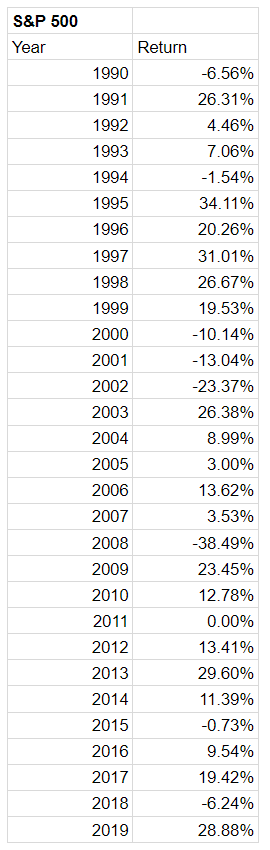
Sequence of returns risk comes from the order in which your investment returns occur. Your investments will earn a return each year and these returns fluctuate (see the returns for the S&P 500 for the 30 years from 1990 to 2019). Even though the average return over that period was 9.11% it fluctuated from +34.11% to -38.49%. 

BUT Does it matter which order the returns come in?

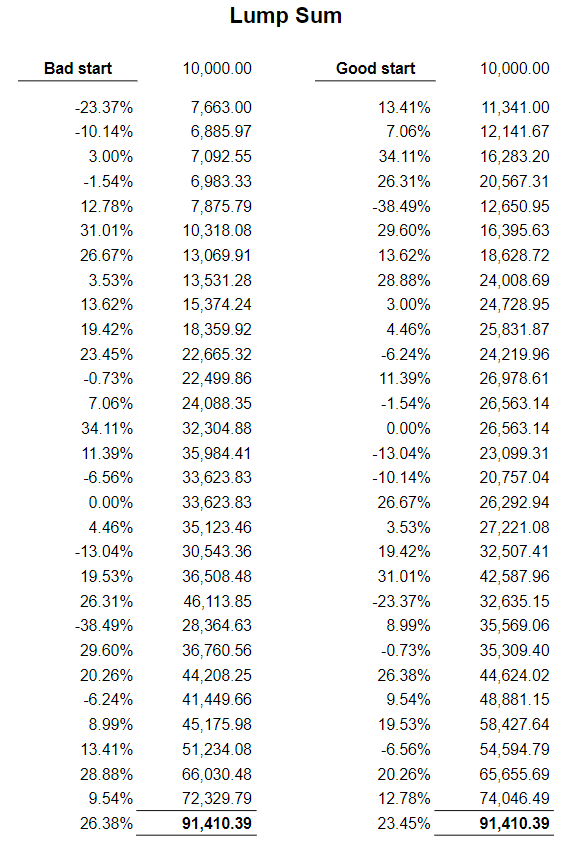
I have reordered the 30-year annual returns into a bad start order and a good start order to examine the impact. The average over the 30 years is still 9.11% using either order. 

Let’s examine the impact of the order of returns in different investment scenarios.

Lump sum investment

Both scenarios start with a lump sum investment of $10,000. After the first 4 years there is almost three times more money with the good start. Yet, both end up in the same place after 30 years. The order of the returns does not matter if there are no contributions or withdrawals.

Annual investment returns source: S&P 500

Lump Sum Investment With Regular Contributions

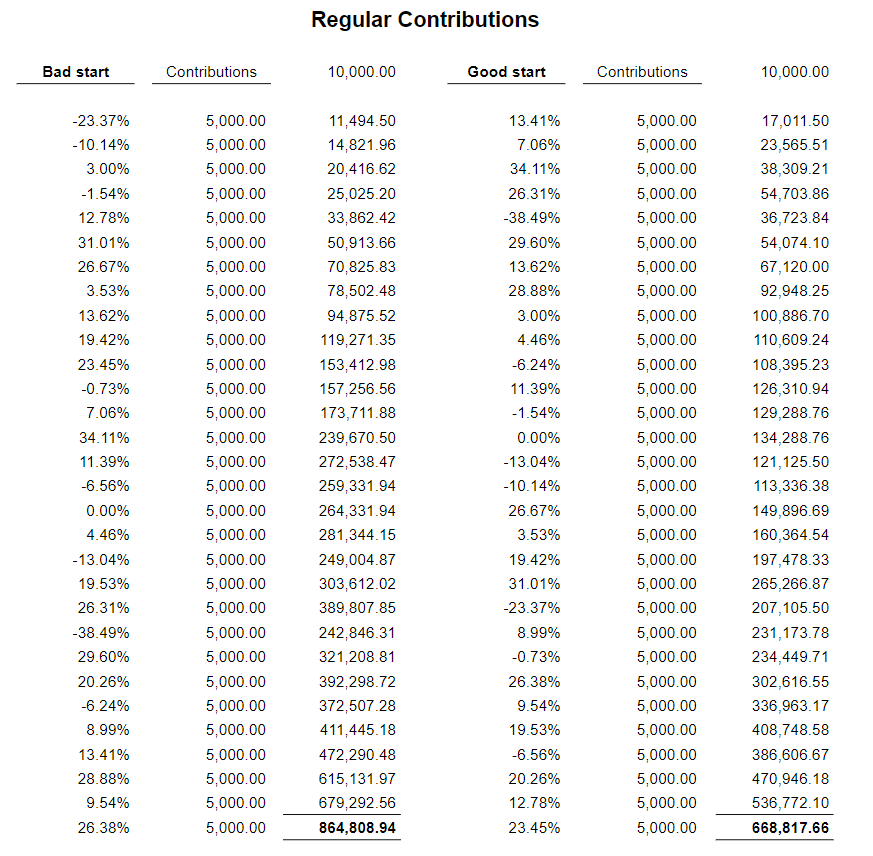
Again, we start with $10,000, but now each year another $5,000 is added. You might expect that a bad start to investment returns would be terrible. In fact, a bad start is better! (As long as the average return is the same).

Under the bad start there is about $865,000 at the end of 30 years while the good start has only $669,000. With the same average return, you would have 29% more money at the end of 30 years if you had a bad start to your investment journey (and a good finish).

Annual investment returns source: S&P 500

Retirement Drawdown

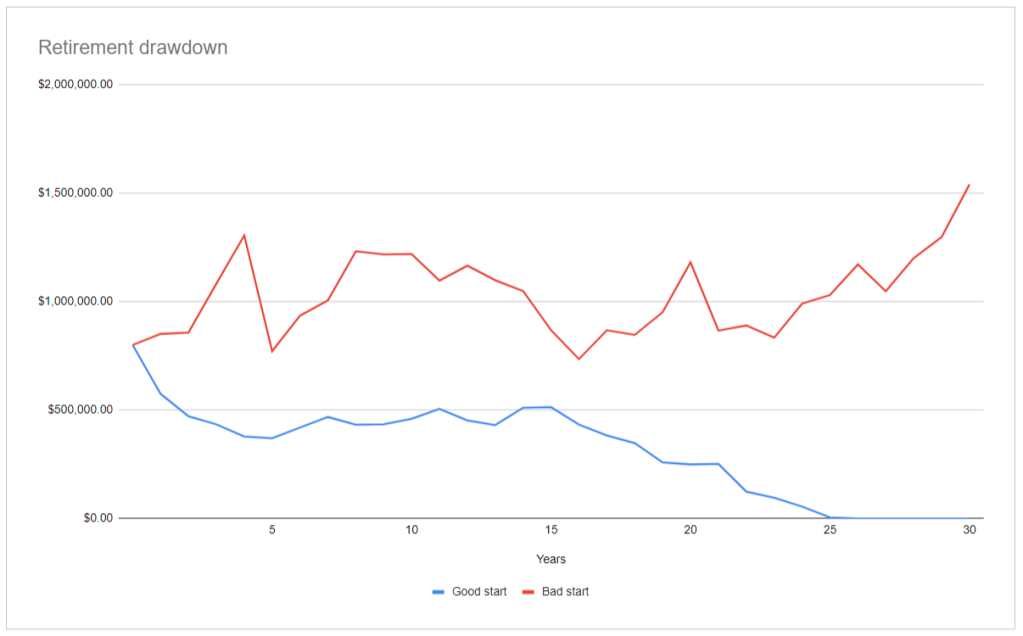
This is the classic scenario when sequence of returns risk is discussed. You have reached retirement with $800,000 and plan to withdraw $50,000 every year for the next thirty years. 

If you happen to retire right before a string of bad investment years your retirement can be severely affected. With the bad start order you run out of money before the end of year 26. Under the good start order you would have $1,539,000 left at the end of the 30 years. This is a massive difference considering the average return is the same. 

Created by Thomson Allison Financial Solutions

What are some solutions?

If you have saved for decades, the last thing you want to hear is that a string of bad years to start your retirement could derail the whole thing. So, what are some strategies to deal with this risk?

There is nothing we can do as investors to change the behaviour of financial markets, but we can mitigate the impacts of sequence of returns risk. Here are two strategies:

1. Flexible Withdrawal Strategy

In years where the market is down you cut spending and reduce withdrawals. This reduces the impact of a down market as more funds are available for the future increases. This strategy has some limitations as spending tends to be difficult to cut.

When markets recover spending can be increased again. The flexibility allows you to weather the storms during retirement.

2. Cushion Strategy

This is a strategy we employ for our clients. Separate the investments into different time periods based on when you expect to spend the money.

  • Short-term (1 – 2 years) is invested in a cash equivalent such as a high-interest savings account.
  • Medium-term (3 – 5 years) is invested in fixed income funds (bonds)
  • Long-term (5+ years) is invested in equity funds (stocks)

The investor’s situation and risk tolerance are an important consideration when applying this strategy.

We refer to the short- and medium-term investment periods as your “cushion” investments. If there is poor stock market performance, you can draw money from the cushion until those investments recover. This avoids withdrawing from assets that are down in value.

Conclusion

Sequence of returns is a legitimate risk when entering retirement and your portfolio should be adjusted to protect your investments. A string of bad investment years as you begin retirement can derail your plan if you are not properly prepared.

The above strategies limit your need to make withdrawals from equity investments during a downturn in the market, protecting your long-term retirement health.

Debt repayment – Snowball vs. Avalanche

We are continuing with the theme of debt repayment. Last month we reviewed how to choose between debt repayment and investing. This month we’ll explore two different debt repayment methods: the snowball method, and the avalanche method.

Snowball Method

The snowball method approaches debt repayment from a psychological and human nature basis by providing positive reinforcement. You repay the smallest debt balance first while making minimum payments on the rest. Then once you have repaid the first debt you tackle the next smallest debt and so on. You do not consider the interest rate of the individual debts. The snowball method focuses on providing wins and positive reinforcement as individual debts are paid off.

Avalanche Method

The avalanche method approaches debt repayment from an efficiency basis. You repay the debt with the highest interest rate first while making minimum payments on the rest. Once that debt is repaid you focus on the next highest interest rate debt. This method aims to minimize your interest costs and get you out of debt as quickly as possible.

Example

You have an extra $500/month you can use to repay debt (after minimum payments). You have the following debts:

  • $4,000 student loan debt at 3.50%
  • $1,000 line of credit debt at 7.00%
  • $5,000 credit card debt at 19.99%

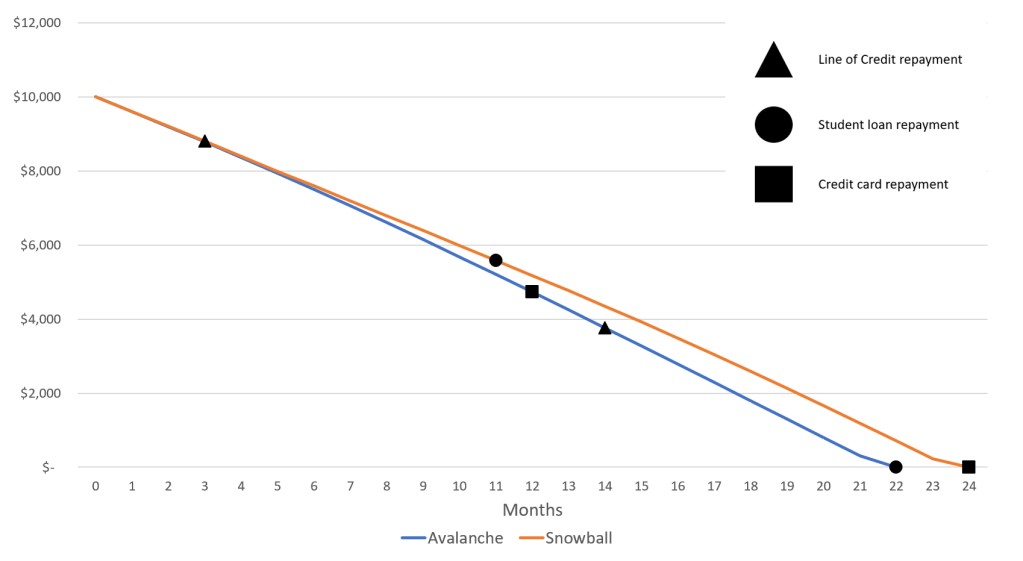
Using the avalanche method the debt is paid off in 22 months and total interest paid is $805.15. Under the snowball method the debt is paid off in 24 months and total interest paid is $1,729.37.

The avalanche method results in less interest and a quicker payoff period. The downside is that it takes about a year to pay off the first debt which may cause you to lose motivation and miss payments. The loss of motivation is even more likely when the debt balances are larger and the payoff periods much longer than what is shown in this example.

Under the snowball method you pay off the line of credit in just over two months and pay off the student loan in under a year. Paying these off provides positive reinforcement and keeps you motivated to repay the remaining debt.

Conclusion

Choosing between the two methods comes down to knowing who you are as a person and what motivates you. Honestly assess yourself. Will seeing individual debts being eliminated motivate you to stay on the journey? Or will knowing you are using the most efficient method be enough motivation for you?

Although we are partial to the most efficient debt repayment option (avalanche), the goal is to continually make progress paying off the debt and putting yourself in a better financial position. Having a good plan that you can stick to is more important than having the perfect plan.

Invest or Repay Debt?

Over the last 15 years this has been an easy question to answer. Unless it was credit card debt (or other high-interest debt) the answer was to invest and only make the required payments on your debt. Interest rates on mortgages were so low there was little financial benefit in paying them off early. With the rapid increase in interest rates over the last year the answer may not be quite so simple anymore.

In general, the best place to deploy excess cash is where it can get you the best long-term rate of return. This has usually been the stock market, for example the S&P 500 has an annual return of 9.0% since 1996 (source: McKinsey).  Over that period, it would have been a better decision to invest excess cash rather than to make extra mortgage payments.

The Financial Impact

Let’s examine what happens if you used $5,000/year to make extra mortgage payments or invested over the 15 years from 2008 to 2022.

Mortgage repaymentInvest
Excess annual cash flow$5,000$5,000
Interest rate/rate of return3.20%*9.50%**
Number of years1515
Change in net worth$94,400$146,800

You would be $50,000 better off at the end of the 15 years if you had invested the money instead of making extra debt payments. This is 50% more net worth on the same $5,000/year.

While the decision to invest was easy over the past 15 years, things have become more nuanced with the increased interest rates. A five-year fixed mortgage is now at 4.50% or higher (source: Ratehub) and at the same time the average home price in Canada fell 12% in 2022 (source: Canadian Real Estate Association).

Other considerations

  1. Risk-free return – The “return” from repaying debt is risk-free but the return from investing is not. If you make an extra debt payment you are guaranteed to pay less interest in the future but the return you get from investing can fluctuate and even be negative.
  2. Anxiety/Stress – Large amounts of debt can cause anxiety and stress. There is often great relief knowing that all your debts are paid off.
  3. Liquidity – If you have an emergency or opportunity, it is easier to liquidate your TFSA then to go and refinance your home.
  4. Diversification – If all your net worth is tied up in the value of your home you are exposed to a large amount of risk if the housing market declines in your area. Meanwhile having a diversified investment portfolio protects you from industry specific or asset class specific risks.

Conclusion

Investing and paying down debt are both good uses for excess cash. Paying off your high-interest debt, such as credit card debt, is the priority. Afterwards the decision becomes more nuanced and personal.

Consider your personal appetite for risk and your relationship with debt. If having a large mortgage causes you anxiety and repaying it aggressively brings you peace and confidence, then that may be the best option for you. If holding mortgage debt does not bother you then investing has almost always been the better option to maximize growth.

The decision also does not need to be either/or, in fact it may be best for you to do a bit of both at the same time.


* Average Canadian fixed mortgage rate from 2008 – 2022 (source: Ratehub)

**S&P 500 rate of return 2008 – 2022 (source: officialdata.org)

Tax-free First Home Savings Account (FHSA)

On April 1, 2023 a new registered account will join the RRSP and TFSA. The Tax-free First Home Savings Account (FHSA) is being introduced to help first-time home buyers save for a down payment.

How does it work?

The FHSA combines elements of the TFSA and RRSP. Similar to an RRSP your contributions are tax deductible. Meanwhile your withdrawals, if used to buy a home, are tax-free like withdrawals from a TFSA. Investment income earned in the plan is also tax-free. These features combine to form an incredibly attractive vehicle to accumulate a home down payment.

Who can open a FHSA?

To open a FHSA you must be:

  • A Canadian resident
  • At least 18 years of age and not over 71 years of age
  • First-time home buyer, meaning you haven’t owned a home in which you lived at any time during the year of account opening or the preceding four calendar years

Contribution limits and rules

  • You are allowed to contribute a total of $8,000 annually, up to a maximum lifetime contribution amount of $40,000
  • Overcontributions are taxed at 1% per month
  • You must open a plan to start accumulating contribution room
  • Unused contribution room can be carried forward. For example, if you contribute $5,000 in 2023 you could contribute up to $11,000 in 2024 ($8,000 – $5,000 + $8,000)
  • The unused contributions you can use in a year is limited to $8,000, therefore the most you can contribute in any one year is $16,000, the $8,000 unused contribution carry forward and $8,000 current year contribution
  • Unlike an RRSP, contributions made within the first 60 days of a calendar year cannot be claimed in the prior year
  • The FHSA deduction does not have to be used in the same tax year as the contribution and can be carried forward to a future year

Withdrawal Rules

For an FHSA withdrawal to be a qualifying withdrawal, you must:

  • Be a first-time home buyer at the time a withdrawal is made. There is an exception that allows you to make a qualifying withdrawal within 30 days of moving into the home
  • You must have a written agreement to buy or build a qualifying home before October 1 of the year following the year of withdrawal and intend to occupy the home as your principal residence within one year after buying or building it
  • A qualifying home would be a housing unit located in Canada
    • A housing share that only provides the right to tenancy in the housing unit would not qualify

If these conditions are met the entire FHSA can be withdrawn on a tax-free basis.

What if i don’t buy a house?

The FHSA can be kept open for 15 years. If at the end of the 15 years you have not purchased a home the following options are available:

  1. Take non-qualifying withdrawal – the withdrawal would be treated as taxable income
  2. Transfer to an RRSP or RRIF – the transfer would happen without an immediate tax impact and would be treated the same as all the other funds in the RRSP/RRIF going forward.
    • The transfer would not reduce or be limited by your available RRSP contribution room.

Treatment on Death

Similar to a TFSA you are able to designate your spouse or common-law partner as the successor account holder. This allows your successor holder to become the new holder of the FHSA upon your death. If the surviving spouse is not eligible to open an FHSA the amount could be transferred to an RRSP/RRIF or withdrawn as taxable income.

If the beneficiary of the FHSA is not the spouse or common-law partner, the funds would need to be withdrawn and would be taxable income of the beneficiary.

Saving for a home – TFSA vs. RRSP vs. FHSA

TFSARRSPFHSA
Annual contributions$6,666.67$6,666.67$6,666.67
Tax savings (20% rate)$0$1,333.33$1,333.33
Total annual contributions$6,666.67$8,000.00$8,000.00
Total contributions (5 years)$33,333.35$40,000.00$40,000.00
Value after 10 years (5% return)$47,015$56,418$56,418
Taxes on withdrawal (20% rate)$0$4,284*$0
Net withdrawal$47,015$52,134$56,418
  • *Home Buyers Plan has a maximum tax-free withdrawal of $35,000. The remaining $21,418 would be taxable income. The Home Buyers Plan (HBP) withdrawals must also be repaid over 15 years.

Other considerations

You can make both a FHSA withdrawal and a HBP withdrawal from your RRSP on the same home purchase. This gives access to the $35,000 of HBP withdrawals plus the balance of your FHSA as tax-free withdrawals for a home purchase.

You can transfer funds from your RRSP to your FHSA to take advantage of the tax-free withdrawal for home purchase. The transfer from your RRSP to FHSA is limited by the FHSA annual and total contribution limit. Therefore, this would only make sense in specific instances.

Conclusion

The FHSA is a better account than both a TFSA and RRSP for saving for a home. The tax-free withdrawals and lack of repayment makes it a better choice than an RRSP. While the tax deductibility of contributions makes it preferrable to a TFSA.

Even if you are not sure if you will buy a home, it should be used for retirement savings before an RRSP because the FHSA balance can be moved to an RRSP tax-free. This gives you an added $40,000 in lifetime RRSP contribution room.

Anyone who qualifies to open an FHSA should do so and deposit at least a nominal amount to begin accumulating contribution room. If you will be purchasing a home in the coming years you should be using the FHSA to save for the down payment.

Taxes 101

Personal income tax filing, everyone’s favourite annual task. Right?

Most Canadians dread having to complete their taxes and with good reason. The tax code in Canada is complex and convoluted. We hope the information presented below will help you make sense of your personal income tax filing in Canada.

Due Dates

  • Income taxes owing need to be paid by April 30th of the following year.
  • Income tax filing is also due April 30th.
    • If you have self-employed income, then the filing deadline is June 15th. Keep in mind the amounts owing are still due by April 30th.

New for your 2022 tax return

  • Repayment of Covid-19 benefits – You may have received a notice in 2021 or 2022 requiring the repayment of a portion of the Covid benefits you received. If you made a repayment in 2022 you will receive a tax slip that can be claimed to reduce your taxable income in 2022, 2021 or 2020.
  • Home Accessibility Tax Credit – If you are 65 or older and are eligible for the disability tax credit you can claim up to $20,000 in Home Accessibility remodels to your home.
  • Ontario Staycation Tax Credit – one time tax credit allowing you to claim 20% of your stay in an Ontario hotel, cottage or campground during 2022 up to a maximum of $1,000 individually or $2,000 as a family.

Common Tax Slips

  • T4 slips – Received in February or early March
    • T4 – Employment income – Provided by each of your employers
    • T4A – Pension, Retirement, Annuity and Other Income – You will receive this if you have pension or annuity income. It is also a “catch-all” tax slip.
    • T4RSP/T4RIF – RRSP/RIF income – Withdrawals from your RRSP/RIF
    • T4A(P)/T4A(OAS) – CPP/OAS income – CPP and OAS pension income and any withholdings tax taken
    • T4E – EI benefits – EI benefits received in the year
  • T5 slips – Received in February or early March
    • T5 – Investment income – Income from any non-registered investment accounts or bank accounts.
    • T5007 – Benefits – You will be issued this slip if you received more than $500 in Worker Compensation benefits, social assistance or provincial supplements.
    • T5008 – Securities Transactions – Disposals or redemptions of any non-registered investments
    • T5013 – Partnership Income – If you were invested in a partnership you will be issued this slip for any income or loss.
  • T3 slip – Investment income (trusts) – Some investments (such as mutual funds) are structured as trusts and they issue T3 slips for any income distributions. These are often issued in March or early April.
  • T2202 – Tuition payments – Tuition payments made in the year will be included on this slip. Issued in February or early March.
  • Foreign Income – If you have income from another country, such as a foreign pension, you will need to report it on your Canadian tax return.

Common tax deductions

These are deducted from your taxable income meaning you save taxes at your marginal tax rate.

  • RRSP/RPP contributions – Contributions to your RRSP or pension plan reduce your taxable income.
  • Split pension deduction – Certain types of pension/retirement income can be split with your spouse, moving income from the higher income spouse to the lower.
  • Union and professional dues – If you pay union or professional dues (that are not reimbursed) these can be deducted.
  • Child care expenses – Payments for child care can reduce your taxable income.
  • Employment expenses – If you are required to work from home, drive to clients (and not reimbursed) or paid through commission there may be an opportunity to deduct some employment costs.
  • Spousal support payments – If you are paying spousal support to your ex-spouse these are deductible from your income. If you are receiving spousal support this would be taxable income.
  • Carrying charges and interest – If you pay investment management fees or you pay interest on a loan used to invest you can claim that as a deduction on your return. Keep in mind this is only deductible on non-registered investments.

Common tax credits

Credits are applied against your taxes payable. In most cases they are at the lowest federal tax bracket of 15% plus your lowest provincial tax bracket. Most credits are indexed to inflation. The majority of credits are non-refundable, which means they can reduce your income taxes to zero but they cannot create a refund on their own.

  • Basic personal amount – Every filer receives this deduction ($14,398 for 2022).
  • Age amount – If you are age 65 or older on December 31st of the tax year you may receive an age amount deduction. It is reduced and eventually eliminated as your income level rises.
  • CPP and EI contributions – You receive a credit for your personal CPP and EI contributions.
  • Employment income credit – You receive a small credit if you have employment income ($1,287 in 2022).
  • Home buyers’ amount – If you are a first-time homebuyer (did not live in a home you own for the tax year and 4 previous years) you get a credit of $10,000.
  • Pension income amount – If you are receiving pension income you receive a maximum credit of $2,000.
  • Disability amount – If you or one of your dependents have a disability please complete a disability tax credit form. If approved you would receive the disability tax credit ($8,870 in 2022).
  • Tuition/education – amounts paid in tuition and education can be claimed as a tax credit. They can also be carried forward if they cannot all be used in the current year.
  • Medical expenses – Only the amount in excess of the lower of:
    • 3% of your net income, or
    • $2,479 (in 2022) can be claimed.
  • Donations – donations to registered charities create a credit on your tax return. On the first $200 they are credited federally at the 15% rate applicable to other credits. Any donations over that amount are credited federally at either 29% or 33% depending on your income tax level. These can be carried forward if they cannot all be claimed in the current year.

These are a selection of the most common and relevant federal tax deductions and credits. There are additional federal and provincial deductions and credits not included in the above lists.